Product Design

20+ years across national and multinational companies, government, publishers and SME / startups. Experienced as a Senior, Principal or a Lead role. Strategic product design and development. Problem-solving & impact-driven.

Case

Detailed
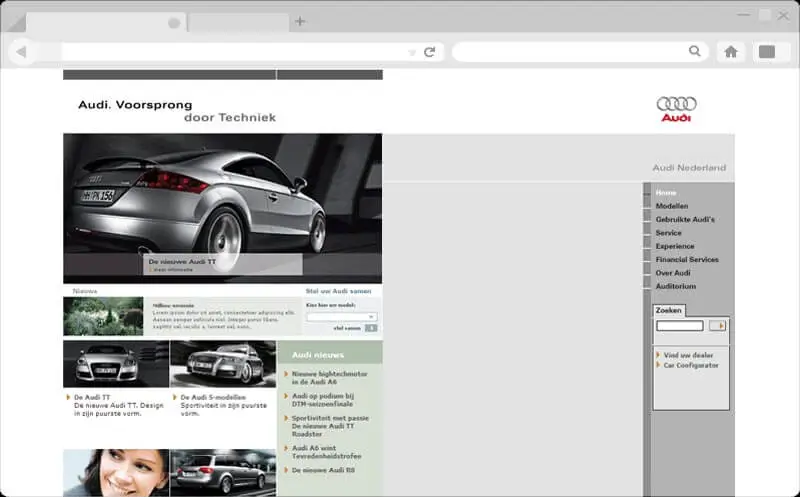
Audi
Website Audi
Website Audi - Models
Case
  • ▪ Industry / Branch
  • Automotive
  • ▪ Role
  • Product Design Engineer
  • ▪ Services
  • Analysis · UX UI Engineering · Prototyping · Web Development · Usability · Optimization

Challenge
  • ▪ Client
  • Audi Netherlands - the Dutch arm of the premium German automotive manufacturer. The project centered on engineering a new User Interface for their Dutch website.
  • ▪ Challenge
  • The goal was to develop a cutting-edge website that adheres to Audi's rigorous global design guidelines. The challenge involved translating the essence of the UI mockups into a Dutch-language version, ensuring it remained true to the Audi corporate global vision.

Role
  • ▪ Summary
  • As a Product Design Engineer, I bridged high-fidelity design with UX Design and front-end development. I collaborated with stakeholders and Java developers to analyze design feedback, and build final front-end pages.

Research
  • ▪ Audit
  • I began with a detailed review of Audi's UI mockups and specifications, identifying key layouts, interactions, and UX pattern behaviors to understand how the elements functioned together for users.
  • ▪ Goal
    1. - Develop a final UI aligned within Audi's styling and brand standards.
    2. - Deliver a smooth, intuitive experience for Dutch users.
    3. - Optimize performance, SEO and CMS integration.

Target
  • ▪ The Dutch
  • The audience expects a smooth digital experience reflecting the vehicle's luxury. Slow load times, inconsistent design, or confusing navigation damage the premium brand image.
  • ▪ Expectation
  • Customers want easy access to model info, configurators and dealer services. Even small visual issues can harm trust and undermine the premium experience.
Persona
  • ▪ The Premium Shopper
    • Role: Affluent professional researching their next vehicle purchase.
    • Age: 38-48
    • Goal: Explore models, compare specifications, and locate dealers with minimal friction.
    • Pain Point: Inconsistent mobile experiences or laggy configurators that feel "unpolished."
    • Quote: "If the website isn't smooth, I question the engineering of the car."
  • ▪ The Corporate Executive
    • Role: C-level executive, company director, or senior partner at a Dutch firm
    • Age: 45–60
    • Goal: Select a premium company vehicle that balances status, comfort, and fiscal efficiency (bijtelling).
    • Pain Point: Limited time. Needs to compare models and specifications quickly between meetings; frustrated by slow-loading configurators or unclear lease options.
    • Quote: "I don't configure cars for fun. I need clarity on price and delivery, now."
  • ▪ The Design-Conscious Professional
    • Role: Architect, creative director, or tech entrepreneur based in the Randstad
    • Age: 30–45
    • Goal: Find a vehicle that reflects personal taste and innovation, not just transport.
    • Pain Point: Mobile-first research. Expects a seamless, visually immersive experience on their iPhone or iPad; poor mobile rendering signals a lack of attention to detail.
    • Quote: "If the mobile experience isn't flawless, I assume the car's interface won't be either."
  • ▪ Persona Insights
    • - Dutch executives prioritize rapid access to fiscal data (bijtelling) and delivery timelines over dense technical specifications common in German UX patterns.
    • - Personas validated the introduction of increased whitespace and simplified navigation, a necessary refinement for the Dutch market within Audi's Design System.

Engineering
  • ▪ Phased
  • Development followed phased cycles, conform to Audi's styling and standards for consistency.
  • ▪ Prototyping
  • The approved UX designs were turned into a high-fidelity prototype, enabling stakeholders to validate micro-interactions before full back-end integration.
  • ▪ Backend
  • Collaborated closely with Java back-end developers to integrate the UI into the CMS, enabling easy content management while maintaining optimal performance and SEO.

Validation
  • ▪ Execution
  • The development followed a systematic approach: optimization, testing, and integration with the Java backend. This phased process ensured continuous quality assurance and early detection of deviations from design.
  • ▪ Collaboration
  • Cross-functional collaboration involved continuous feedback among UI engineering, stakeholders, and backend team, ensuring the technical implementation aligned with Audi's brand values and met speed and SEO requirements.

Final
  • ▪ Dutch website
  • The completed Audi Netherlands website perfectly embodies the brand's premium identity with a sleek, modern design, modern navigation and fast load times.
    A collaborative effort in design, engineering, and development created a scalable, high-performance platform.
Technical Highlights
  • ▪ Performance
  • Optimized for speed and search visibility, enabling customers to find information quickly.
  • ▪ Fidelity
  • Adhered to Audi's Design System for a consistent, premium user experience across all devices.

Results
  • ▪ Impact
  • The new website met Audi's high design standards, improved user experience in the Netherlands, modern navigation, better access to information, and reinforced Audi's commitment to quality with a strong technical foundation.
  • ▪ Key takeaways
    • - Stick to corporate guidelines: Pixel-perfect implementation builds user trust for premium automotive brands.
    • - Engineering equals experience: Fast load times and smooth interactions are as important as visuals in luxury.
    • - Collaboration matters: Phased, integrated work ensures a robust, scalable product.

Go to Cases


Contact

& get in Touch

aalleexxxxwwoorrkkss..ppaaggeess..ddeevv
aalleexxxxwwoorrkkss@@pprroottoonn..mmee
++3311((00))662200551199557722